
School culture does not happen by accident. It is built through relationships, shared values, meaningful traditions, student voice, high expectations, and a belief that every student should feel known and connected to their school.
At Nauset Regional Middle School, our goal has been to create a school students do not simply attend, but one to which they feel they belong. We want students to have adults who know them well, peers beyond their immediate classroom or grade level, opportunities to lead, reasons to take pride in their school, and experiences that make middle school memorable.
Our motto, “Where Every Child Matters,” reflects that commitment. Several interconnected structures help turn that belief into the everyday experience of our students.
The House System
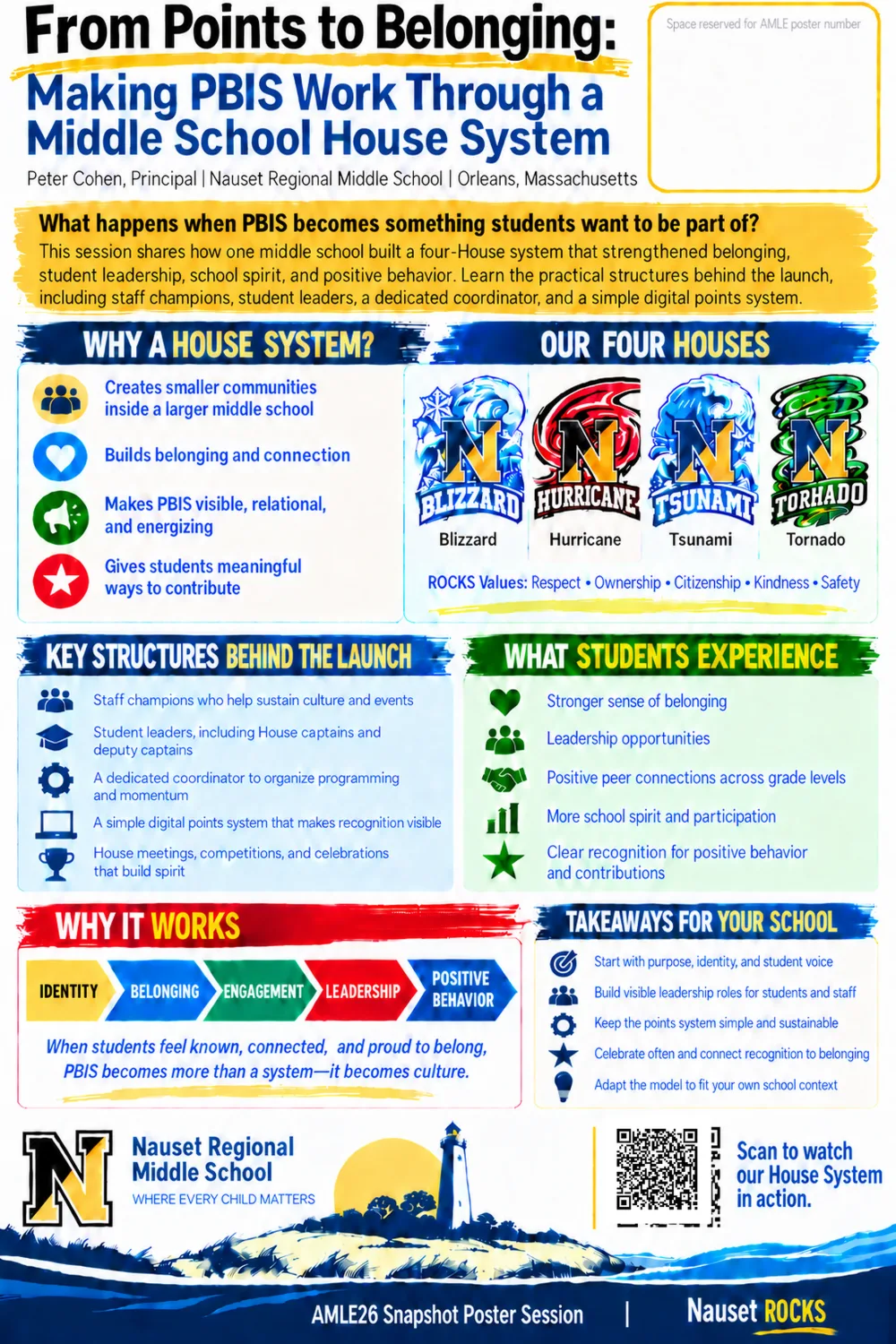
Blizzard • Hurricane • Tsunami • Tornado
Our four-House system is one of the primary ways we create connection, identity, and school spirit at Nauset.
Every student and staff member belongs to one of four Houses: Blizzard, Hurricane, Tsunami, or Tornado. The Houses intentionally create smaller communities within the larger school and bring together students and adults from across grade levels.
The goal is much larger than competition or earning points. The House System gives students a group with which to identify, creates opportunities for older students to lead younger students, builds traditions, and provides another way for students to feel that they are part of something.
House points recognize academic effort and achievement, kindness, citizenship, leadership, perseverance, preparedness, attendance, school spirit, and the many other positive contributions students make each day. House competitions and celebrations add fun and energy, but the larger purpose is belonging.
The result is a system in which positive behavior, achievement, relationships, leadership, and school pride reinforce one another.
Nauset ROCKS
Respect • Ownership • Citizenship • Kindness • Safety
Our ROCKS values provide a common language for the kind of community we want to create.
Rather than maintaining a long list of rules for every possible situation, we want students to understand a smaller set of values that can guide their decisions throughout the school day.
Respect means treating people, ideas, spaces, and ourselves with dignity.
Ownership means taking responsibility for our choices, effort, learning, and impact on others.
Citizenship means contributing positively to our school and larger community.
Kindness means recognizing that our words and actions matter and looking for opportunities to support others.
Safety means making choices that protect the physical and emotional well-being of ourselves and those around us.
These values are visible throughout the building and incorporated into recognition, House points, student conversations, and school expectations. The goal is not simply for students to know what the letters stand for. We want the ROCKS values to become part of how students and adults think about what it means to be a member of our community.
Belonging Begins With Being Known
One of the most important questions a school can ask is simple:
Does every student have an adult in the building who knows them well?
At Nauset, Nauset Time helps us work toward that goal.
Students meet in small advisory groups with a consistent adult who serves as another advocate, mentor, and connection to school. Nauset Time creates space for academic planning, extra help, organization, enrichment, reflection, relationship building, and conversations that do not always fit neatly within an academic class.
Because advisory groups are intentionally small, adults have an opportunity to notice when something has changed. They can celebrate successes, help students solve problems, connect them with support, and make certain that students do not become anonymous within a larger institution.
Middle school students need independence, but they also need to know that adults are paying attention.
Student Leadership
Students should have opportunities not simply to participate in school, but to help shape it.
The House System creates multiple layers of authentic student leadership.
Eighth-grade students serve as House Captains, while seventh-grade students serve as Deputy Captains. These students help lead House meetings, teach traditions to younger students, organize activities, generate ideas, build school spirit, and represent the interests of their Houses.
Students also serve as members of the Crew, taking visible leadership roles throughout the school community. They may welcome families, guide visitors, assist at school events, support younger students, and serve as ambassadors for Nauset.
Within Houses, students can take responsibility for committees focused on areas such as spirit, decorating, service, competitions, and special events.
Authentic leadership means more than giving students titles. Adults have to be willing to give students meaningful responsibility—and sometimes allow their ideas to take the school in directions we did not anticipate.
When students see evidence that their ideas can influence their school, they develop greater ownership of the community they are helping to create.
Traditions Create Community
Schools need traditions.
Some of the most powerful memories students carry from middle school have little to do with a particular assignment or test. They remember an assembly, a performance, a game, a competition, a teacher who made them laugh, a moment when their House won, or an experience shared by the entire school.
At Nauset, we intentionally create those moments.
House competitions, spirit days, dances, concerts, athletic events, assemblies, reading challenges, service opportunities, Pack the Gym events, House Olympics, and other activities give students reasons to participate in the life of their school.
We also look for ways to introduce surprise and playfulness. Our Golden Ticket Mysteries, for example, turn the school itself into a puzzle as students follow clues and work together to discover a hidden ticket somewhere in the building.
These experiences may appear small individually, but collectively they create something important: shared history.
Students begin to say “At our school, we…”
That sense of “we” is one of the clearest signs that a school community is taking hold.
Recognition With a Purpose
Positive reinforcement can easily become transactional: do something good, earn a point, receive a prize.
We want it to mean more.
Our recognition system is designed to help students understand that their everyday choices contribute to the culture of the school.
Students can earn House recognition for academic excellence and growth, effort, perseverance, preparation, attendance and punctuality, leadership, citizenship, kindness, respect, safety, and school spirit.
That intentionally broad definition matters.
A student who earns an outstanding grade deserves recognition. So does the student whose grade improves because of extraordinary effort. So does the student who helps someone who is struggling, arrives prepared every day, demonstrates perseverance, includes another student, or quietly makes the school a better place.
Recognition communicates what a community values.
When schools consistently notice those behaviors, students begin to understand that achievement and character are not competing priorities. Both matter.
Learning Beyond the Classroom
Belonging also grows when students see a connection between what they learn in school and the community around them.
Programs such as Earth Keepers and Change Makers provide interdisciplinary and place-based learning experiences that connect students with Cape Cod’s environment, history, community organizations, and real-world challenges.
These experiences allow students to investigate authentic problems, collaborate across disciplines, work with community partners, and see themselves as people capable of contributing beyond the walls of the school.
Our location on Cape Cod provides an extraordinary classroom. Whenever possible, we want students learning not only about their community but with and within their community.
Culture Is the Work
It can be tempting to think of school culture as separate from academics.
I see them as inseparable.
Students are more willing to take academic risks when they feel safe. They persevere when adults believe in them. They engage when they feel connected. Teachers innovate when they feel trusted. Families become partners when they feel welcomed. And schools become stronger when students believe that they have a meaningful role within them.
The House System, ROCKS values, Nauset Time, student leadership, recognition, traditions, and place-based learning are individual structures, but they serve one larger purpose:
To create a school where students feel known, valued, challenged, connected, and proud to belong.
That is what we mean when we say Nauset Regional Middle School is a place Where Every Child Matters.